

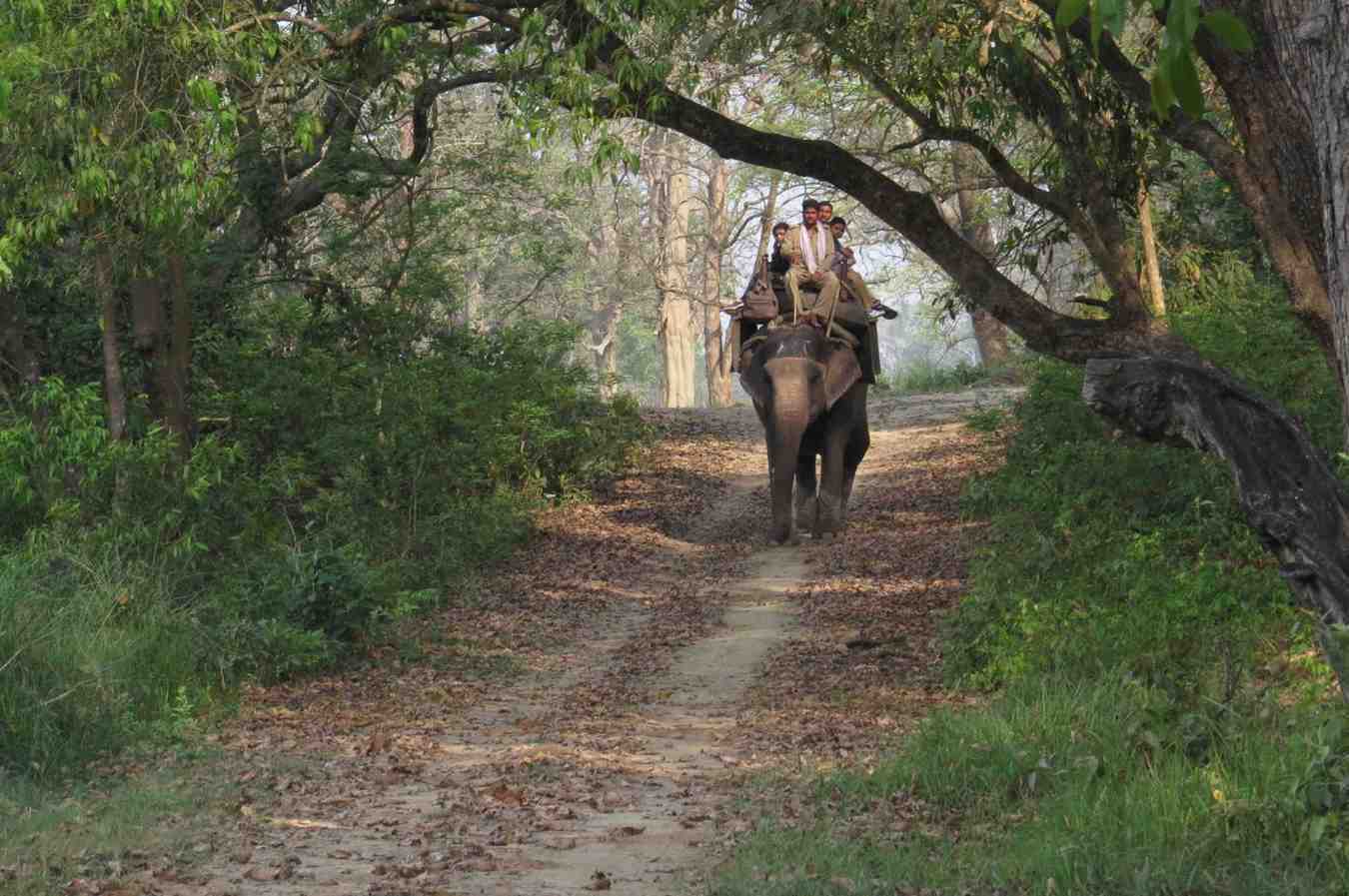
Photo Banner Caption: Tourists riding an elephant during a jungle safari in Dudhwa Tiger Reserve. Pic Credit- Sanjay Singh, ex Field director, Dudhwa
With elephant safari having been resumed in Jim Corbett and Rajaji National Parks of Uttarakhand after a 7-year hiatus, the issue of elephant tourism is under focus once again with greens in protest, citing cruelty, abuse and psychological trauma to elephants, though many, including foresters, differ. TreeTake takes a look …
An elephant safari is a guided tour, usually in national parks in Asia (like India or Thailand), where one rides a trained elephant, led by a mahout (handler), to explore dense jungles and spot wildlife from a unique, elevated vantage point, offering close-up views of animals like tigers, rhinos, and birds that might be missed in a jeep. It is a traditional way to experience wilderness, providing access to areas unreachable by vehicles, though it is increasingly met with ethical concerns about animal welfare.
An elephant safari is said to offer a unique perspective of jungle life. Elephants can navigate thick forests and difficult terrain where jeeps cannot go, getting one closer to wildlife. It is a guided experience, since a mahout steers the elephant and provides expert knowledge about the flora and fauna. It is said to be ideal for spotting animals like tigers (in "tiger shows"), rhinos, bears and various bird species. It has a conservation connection too, as some parks use fees from safaris to fund conservation, while also offering rehabilitation for rescued elephants.
However, green activists voice ethical concerns about elephant safaris. Some organisations argue that elephant riding exploits animals, leading to bans or stricter regulations in certain areas and bat for jeep safaris, walking trails and boat trips as alternative ways to experience wildlife, often with lower environmental impact and no animal riding.
India offers elephant safaris in numerous national parks and sanctuaries, with popular spots in Kaziranga (Assam), Jim Corbett (Uttarakhand), Periyar (Kerala), Bandipur & Nagarhole (Karnataka), and Mudumalai (Tamil Nadu), providing unique ways to see elephants and other wildlife in diverse terrains from dense forests to grasslands. Other great locations include Manas (Assam), Rajaji (Uttarakhand), Kanha & Bandhavgarh (MP), and Jaldapara (West Bengal). Jim Corbett National Park, Uttarakhand, is one of India's oldest parks, great for elephant rides. Kaziranga National Park, Assam, is famous for rhinos, but also offers elephant safaris for spotting tigers and elephants. Bandhavgarh National Park, MP, is known for tigers, but also offers elephant safaris. Kanha National Park, MP, offers joy rides and is a good spot for wildlife. Rajaji National Park, Uttarakhand, is a key elephant reserve, especially good in the dry season. Pench National Park, in MP, is another popular choice for elephant safaris. Periyar National Park
Why is the elephant safari opposed?
Animal activists say the majestic creatures deserve respect and freedom, just like humans. They primarily oppose elephant safaris, citing significant concerns about animal cruelty, physical harm to the elephants, and their poor living conditions in captivity. The industry has faced legal challenges and bans in various regions and many travel companies and animal welfare organisations have stopped offering or promoting such activities. To note, the Uttarakhand High Court had banned the commercial use of elephants in 2018 under the Prevention of Cruelty to Animals Act, 1960, and the Wildlife Protection Act, 1972. The ban has now been lifted, after the Supreme Court intervened in 2019, allowing controlled, regulated safaris to restart with new rules for animal welfare and conservation, much to the relief of local tourism and conservationists, despite ongoing ethical debates. The new rules include shorter routes, veterinary supervision, and a focus on conservation, with fees set at Rs 1,000 (Indians) and Rs 3,000 (foreigners) per ride. As per officials, the reasons for resumption include closer wildlife viewing, eco-tourism benefits, connecting youth with forests and supporting local mahouts and economies.
However, animal welfare groups still raise concerns about potential exploitation and the fundamental ethics of using elephants for tourism, even with new rules.
Animal welfare activists allege that to make wild elephants submissive and "safe" for human interaction, they often undergo a traumatic process known as "phajaan" or "the crush". This involves separating young elephants from their mothers, confining them in small spaces and using physical abuse (such as beatings with bullhooks or sharp sticks), starvation and sleep deprivation to break their spirit. They also say elephants' spines are not anatomically designed to carry heavy loads, such as a saddle (howdah) with multiple tourists, and constant weight can lead to permanent spinal injuries, deformities and chronic pain. The equipment itself can cause painful sores and infections. They also allege captive elephants are often denied natural behaviour, like foraging and socialising. They may be chained for long periods, kept on hard concrete surfaces that cause foot and joint problems and receive inadequate nutrition or veterinary care. These conditions contribute to a significantly reduced lifespan compared to wild elephants.
Another reason cited is that the demand for captive elephants fuels the illegal capture and smuggling of wild calves, which directly impacts the conservation of endangered wild elephant populations and disrupts their complex social structures.
The greens say that the elephants are overworked. They work long, gruelling hours, often under the blazing sun. Working tirelessly without adequate rest, proper nourishment, or enough water has severe implications for the health of these gentle giants. When put to work, elephants’ natural behaviour is heavily restricted, and their physical needs are ignored. Even when they are resting, many elephants remain chained and constricted. As per the World Animal Protection, elephants who live in captivity have a drastically reduced lifespan compared to those living in the wild. Chronic stress, inadequate living conditions, and improper diet in captivity contribute to their premature deaths. Boycotting elephant rides contributes to efforts that help elephants live longer, healthier lives.
It is said that elephants are highly social animals with complex behaviours and communication systems. But the tuskers that are used in tourism often do not get a chance to interact naturally with others of their ilk, which has an adverse impact on their mental health. Doing away with elephant rides would help preserve their natural social structures and allow them to interact freely and naturally with others of their ilk.
It is also said that stressed or abused elephants can behave unpredictably, posing a danger to both handlers (mahouts) and tourists. There have been several documented incidents of elephants attacking or running amok. This is why animal welfare groups underline that the inherent cruelty in training and use makes elephant safaris unethical.
Sumanth Bindumadhav, director of Wildlife Protection in Humane Society International (HSI), India, was quoted in a report as saying that elephants were forced to wear heavy ‘elephant saddles’ on their back, which could cause pressure sores, on which a tourist would sit, plus a mahout sitting on the elephant’s neck. In some cases, these elephants could be ridden like this for around eight hours a day, creating continuous pressure on their back. This pressure could cause spinal deformities later in life. Bindumadhav was quoted as saying that although elephants were very large creatures, their backs were not very strong.
Animal activist and founder of Nature Club Gonda, Abhishek Dubey, said: “Elephant riding in jungle safaris is cruel for the animals and unsafe for people. To train elephants for rides, they are often taken away from their mothers, tied with chains, hit with sharp tools, and kept hungry or tired so they become fully controlled by humans. Heavy seats and many tourists on their backs damage their spine, feet, and skin, and they cannot live a natural life, walk freely, or stay with their herd.”
“When people ride or bathe with elephants, the message is that wild animals are for fun and profit, not living beings with rights and feelings. This increases demand for more elephants in tourism, so more are captured or bred for a life of suffering in captivity. It is also risky, because elephants are strong wild animals and accidents can seriously injure or kill tourists and mahouts. Elephant riding should stop and tourism should change to kinder options like watching wildlife from jeeps or on guided walks from a safe distance and visiting true sanctuaries where there is no riding, no shows and very limited contact. Responsible tourism means keeping noise low, staying on fixed routes, not feeding or touching wild animals and making sure money supports habitat protection and local communities, not cruel animal attractions,” he added.
Director of Conservation projects, Wildlife SOS, Agra Baiju Raj said: “There are two dimensions of this. Elephants should not be used at all for safari, that is wrong.) But the elephants living in the camp, compared to the elephants living on the street, are in much better condition than that. Tuskers should be used for patrolling, be it tiger patrolling or rhino patrolling; it is not wrong, because a single man sits on it and goes and one can go close to the tiger. But in safari, a howdah is placed on the animal’s back and several people sit in it. Moreover, the riders have very little civic sense; they will sit or move about, causing injury to the animal’s spine. I know this because many elephants come here after being rescued. There should be more public awareness, so that people do not opt for it. Last year also an elephant also came to our centre; its spine was completely bent, so rides cause so much damage. However, it is fine for patrolling. A person is going there to observe; there is no harm in that.”
Arguments against a complete ban
Contrary to the above claims, many people are of the opinion that a complete ban is not feasible, in view of contexts and livelihoods. Advocates of elephant safari say there are millions of people in India and Nepal who derive income and succour from elephant tourism. A sudden ban on elephant safaris without providing viable alternatives could lead to job losses. They suggest that strictly monitored, low-impact elephant safaris can provide revenue to fund habitat preservation, anti-poaching patrols and other conservation efforts in national parks that are inaccessible to vehicles. Some also believe that controlled interactions can help connect younger generations with wildlife and conservation, fostering an appreciation for these animals.
Elephant safaris are important for providing unique, elevated perspectives into dense jungles, accessing areas inaccessible to jeeps, offering close yet safe wildlife viewing, connecting tourists with local culture, and creating sustainable economic support for elephant conservation and mahout communities, though concerns exist regarding animal welfare. They offer an intimate way to experience biodiversity and see animals like tigers and rhinos, while preserving traditions and funding elephant care.
The proponents of elephant safaris also say that tuskers can traverse thick forests, deep valleys and difficult terrain that jeeps cannot, offering access to hidden wildlife. Riding on an elephant gives a height advantage, provides a unique vantage point for spotting wildlife and enjoying breathtaking scenery. It also offers a close-up, sensory experience of the jungle, smelling fragrant plantations and feeling the slow, tranquil pace, as seen in places like Kerala and Corbett National Park. Another argument is that the experience connects tourists with the history of elephant-riding, a tradition from India's royal past, and supports mahouts (elephant handlers). They put forth the view that jeep safaris are better for wider, track-based viewing, often more economical for general tourists and provide constant surveillance for anti-poaching efforts. But elephant safaris are best for deep jungle immersion and specific photography/filming, offering a more traditional, slower, and immersive journey.
Field director of Dudhwa National Park ( which offers elephant safari), Raja Mohan, said he had never observed any injury to any tusker on account of a safari. The animals were used in rotation so that there was no pressure on any one tusker, and there was a dedicated veterinarian to look after and monitor their health. The safari was operated as per rules, and there were fixed timings, with only four people allowed to ride at a time. “We have never separated a calf from its mother. We got a few elephants from other states and raised two calves abandoned by their mother,” he said. To note, elephant safari is not available at Dudhwa in this current season.
Former senior forest official Mohd Ahsan said: “Elephants have been used for various kinds of work since time immemorial. Why are only elephants, even horses and bullocks are used? Cows and buffaloes are milked. Does it cause them pain? This needs to be defined. It is not wise to stop bona fide activities. What is more, even animals adapt and adopt.”
DFO of Pilibhit Tiger Reserve Manish Singh said that though some studies had shown that the tuskers suffered spinal injuries due to people riding them, it was more a question of ethics.
Conclusion
The general consensus among animal welfare experts and growing numbers of aware tourists is to shun elephant rides. However, instead of a complete, abrupt ban that could displace elephants and their caretakers without a plan, they advocate well-managed, ethical tourism models that prioritise elephant welfare and allow for observation rather than interaction. The alternatives include jeep and Canter safaris, cited as the most popular alternative, for they allow tourists to cover large areas quickly. They are said to be ideal for tiger sightings in places like Ranthambore, Bandhavgarh or Tadoba. Walking safaris ensure deep immersion in the forest, focusing on smaller details, birds and tracking, often with experienced guides. Boat safaris are said to be excellent for birdwatching and seeing animals at riverbanks, offering tranquillity, as seen in Chitwan, Nepal. ([email protected])



Leave a comment